
Table of Contents
What Is Martial Law and Its Core Meaning
Martial law is a special legal condition in which a country temporarily places its civilian administration under military control. It is generally declared during extreme national emergencies when normal law enforcement, judiciary, or government systems are unable to function effectively. The term is often associated with war situations, large-scale civil unrest, or national crises that threaten public order and security.
In practical terms, martial law means that the military takes responsibility for maintaining law and order instead of civilian authorities. This may include enforcing curfews, controlling movement, managing public safety, and in some cases overseeing administrative functions. However, the exact scope of it depends on the constitutional framework of each country.
Although many people assume it means complete suspension of law, in reality it is usually a structured system of emergency control. It is designed to restore stability, not permanently replace civilian governance, although history shows that misuse can sometimes lead to extended military rule.
Historical Background and Development of Martial Law
The idea of it has roots in ancient and medieval societies where military leaders were often given authority during war or rebellion. In early civilizations, when central governance weakened, armies were the only structured force capable of maintaining order. Over time, this evolved into more formal legal systems defining when military authority could replace civilian control.
In European history, martial law became more structured as modern legal systems developed. During periods of war, especially in the 17th and 18th centuries, governments frequently relied on military enforcement to maintain internal stability. As democratic systems evolved, strict rules were introduced to limit the use of it and prevent abuse of power.
In modern times, it has been declared in various countries during wars, coups, and internal conflicts. Its historical use shows a pattern where governments turn to military control during moments of instability, but the long-term effects vary depending on how responsibly it is implemented.
Legal Framework and Constitutional Authority
The legal basis of it differs from country to country, but it is usually rooted in constitutional or emergency provisions. In some nations, the constitution clearly defines when martial law can be declared, while in others it is based on executive emergency powers.
Typically, it is authorized when there is a severe breakdown of civil order, invasion, rebellion, or disaster that overwhelms civilian authorities. In such cases, governments may transfer authority to military commanders for a limited period. Courts may still function, but their powers can be restricted or supervised.
Despite its legal foundation, it is considered one of the most sensitive powers of a state. It must be justified by clear necessity, and in many democratic systems, it is subject to judicial review or parliamentary oversight to prevent misuse or long-term authoritarian control.
Conditions That Lead to Martial Law Declaration
it is usually declared only in extreme situations where normal governance fails. One of the most common triggers is large-scale civil unrest, where protests, riots, or armed rebellion make it impossible for police forces to maintain order. In such cases, military intervention is seen as a last resort.
Natural disasters can also lead to it when the scale of destruction is too large for civilian emergency services to handle. Earthquakes, floods, or widespread infrastructure collapse may require military coordination to restore basic services and ensure public safety.
Political instability is another major factor. During coups or government breakdowns,it may be used to stabilize the situation temporarily. In all scenarios, the central aim is to restore control and prevent further escalation of chaos.
Authority and Control Under Martial Law
When it is in effect, military authorities assume control over public administration and security operations. This may include enforcing curfews, restricting travel, and monitoring public gatherings. The goal is to maintain order and prevent violence during unstable conditions.
In many cases, military tribunals or special courts may be established to handle legal matters. Civil institutions may continue to function, but often under supervision or limitation. The extent of military authority depends on how the martial law is declared and what powers are legally granted.
Even though military control is expanded, it is generally intended to be temporary. Most legal systems require that normal civilian governance be restored once stability is achieved, ensuring that it does not become permanent.
Effects of Martial Law on Civil Life
Martial law has a direct and often significant impact on everyday life. Civil liberties such as freedom of movement, assembly, and sometimes expression may be restricted to maintain order. Curfews and checkpoints are commonly introduced to monitor public activity and reduce risk of unrest.
Daily routines can be heavily disrupted during martial law. Schools, businesses, and transportation systems may operate under restrictions or be temporarily suspended. This can create uncertainty and economic disruption, especially if it continues for an extended period.
At the same time, martial law can also bring a sense of stability in highly chaotic situations. By restoring order quickly, it may help prevent further damage and allow essential services to resume gradually.
Difference Between Martial Law and State of Emergency
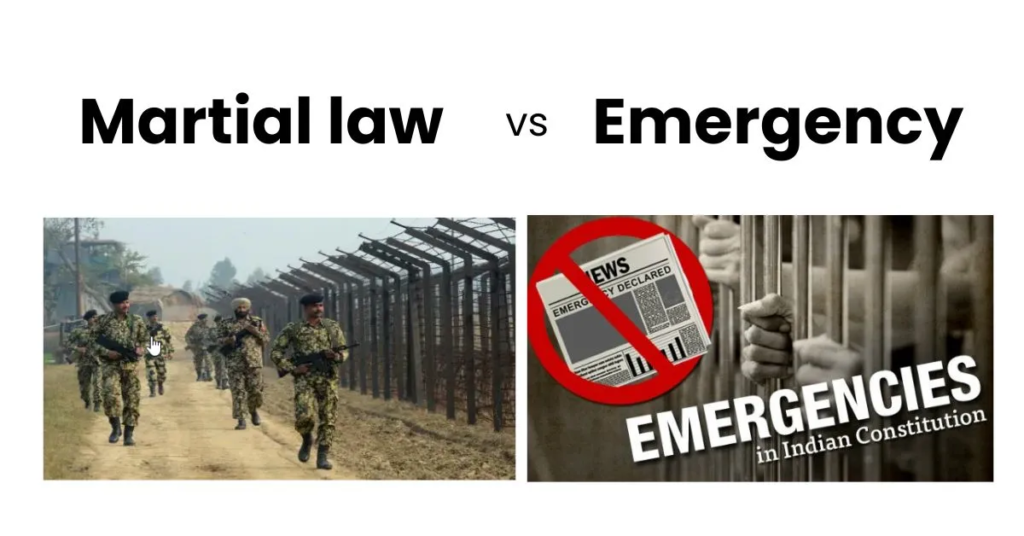
it is often confused with a state of emergency, but they are not the same. A state of emergency allows the government to expand its powers while still keeping civilian institutions in control. Martial law, however, transfers authority directly to the military.
Under a state of emergency, police, courts, and civil administration continue to function, although with enhanced powers given to the executive. In contrast, martial law may replace or override civilian systems with military command structures.
This distinction is important because martial law represents a more extreme form of governance change. It is typically used only when emergency powers are not sufficient to restore order.
Historical Examples and Global Usage
it has been used in many countries throughout history, often during times of war, political instability, or internal conflict. In some cases, it has helped restore order during national crises, while in others it has led to prolonged military rule.
In several historical instances, martial law was introduced during political unrest and later extended beyond its original purpose, raising concerns about democratic erosion. In other cases, it was successfully lifted after stability returned and civilian governance resumed.
These examples show that martial law is a powerful but sensitive tool. Its effectiveness depends largely on how responsibly it is implemented and how quickly control is returned to civilian authorities.
Advantages and Risks of Martial Law
One of the main advantages of martial law is its ability to restore order quickly in situations where civilian systems fail. Military forces are organized, disciplined, and capable of responding rapidly to emergencies, making them effective in crisis management.
However, martial law also carries significant risks. Restrictions on civil rights, potential misuse of power, and lack of transparency can lead to public concern. If extended too long, it may weaken democratic institutions and reduce public trust in governance.
Because of these risks, most legal systems emphasize that martial law must be temporary, necessary, and carefully monitored. Its success depends on balancing security needs with the protection of fundamental rights.
Conclusion on Martial Law and Its Importance
Martial law is a complex and powerful legal mechanism designed to handle extreme national emergencies. It allows military authorities to take temporary control when civilian systems fail, ensuring that order and security can be restored.
While it can be effective in crisis situations, it also raises serious concerns about civil liberties and democratic governance. Its use must always be justified, limited in time, and carefully regulated to prevent misuse.
Ultimately, martial law represents the tension between security and freedom. Understanding it helps explain how governments respond to extreme crises and why strict safeguards are necessary to ensure that temporary military control does not become permanent rule.